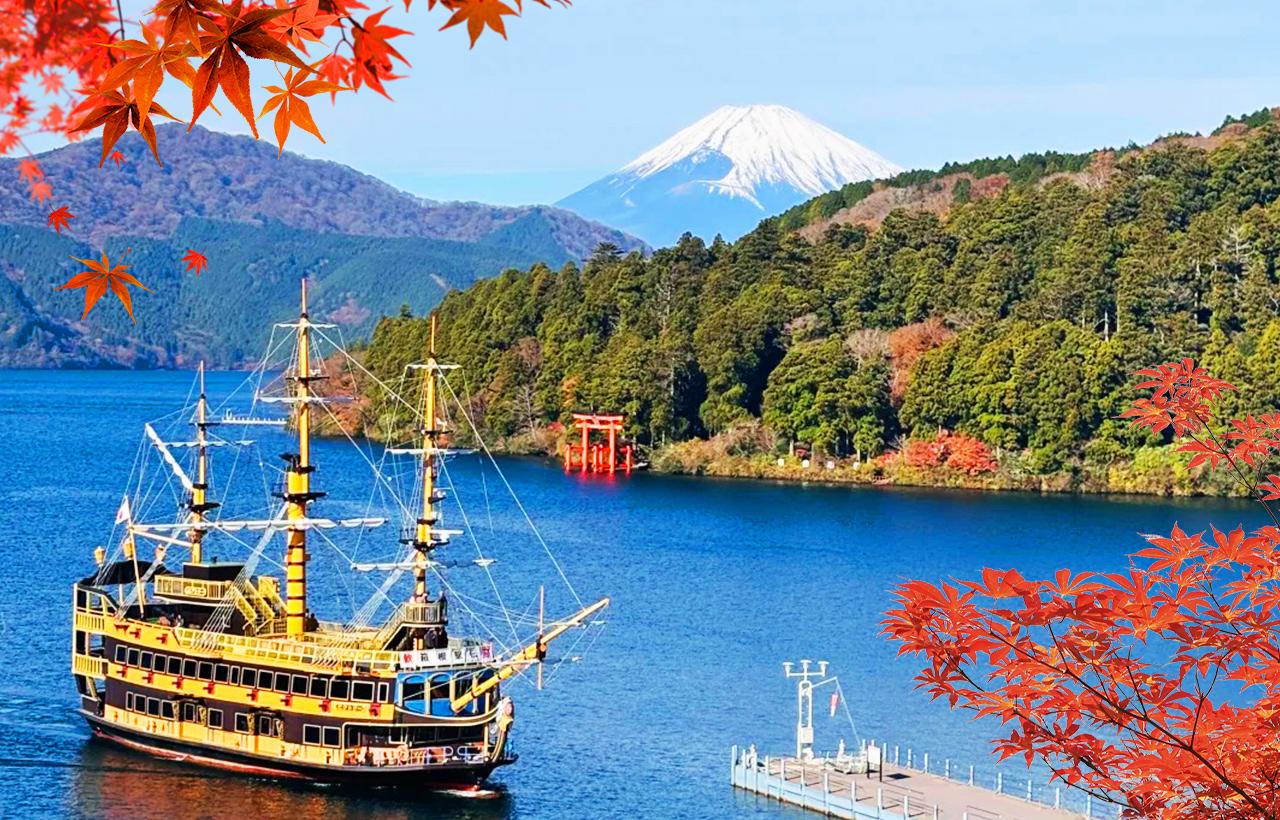
Owakudani and the Hakone Ropeway
Is Owakudani open, what the Hakone Ropeway costs, why it closes, the black eggs, and how long to stay. Fares and status checked October 2026.
Owakudani is open, and the Hakone Ropeway runs over it daily, but both can shut at short notice. The ropeway stops in very strong wind and whenever its own sensors read high volcanic gas, and that can happen on a day when the official volcano alert is at its lowest level. The alert for Mount Hakone stood at Level 1, the normal setting, when we checked in September 2026.
The simplest way to see it is on a day trip that includes the ropeway fare: the most-booked one from Tokyo costs $55 per person, is rated 4.6/5 from 8,374 reviews, and if the ropeway stops on your day the guide switches the route. (Checked October 2026.)
What Owakudani is
Owakudani, the “Great Boiling Valley”, is the crater left by Mount Hakone’s last major eruption about 3,000 years ago. The hillside still steams. Sulphur vents hiss among yellow-stained rocks, the air smells of eggs, and on a clear day Mount Fuji stands behind it all. It is also where much of Hakone’s hot water comes from, which is why the valley sits at the centre of every onsen story in the region.
You do not pay to enter Owakudani itself. You pay to get there, and almost everyone gets there by ropeway.
The Hakone Ropeway: route and fares
The ropeway runs from Sounzan, at the top of the cable car from Gora, over the ridge to Owakudani station, then down to Togendai on the shore of Lake Ashi. You change cabins at Owakudani, so it is a natural place to get off. End to end, Sounzan to Togendai takes about 50 minutes including the change.
| Ticket | Adult | Child |
|---|---|---|
| One way, any distance | ¥2,000 | ¥700 |
| Return | ¥3,000 | |
| Hakone Free Pass | Included | Included |
Fares as listed in October 2026, after the October 2025 fare revision. Several older guides still quote ¥1,500, which is out of date.
If you hold a Hakone Free Pass, the ropeway is included in it. If you are on one of the classic day trips, one ropeway ride is usually part of the ticket.
Why the ropeway closes
There are four reasons, and only one has much to do with eruptions.
- Wind. The line stops in very strong wind and ahead of typhoons and thunderstorms. This is the most common cause.
- Volcanic gas. Owakudani gives off hydrogen sulphide and sulphur dioxide all the time, and the ropeway measures them along the line. If the readings rise, a section stops, sometimes without warning. The operator says gas levels have no direct link to the national alert level.
- Maintenance. Sections close for planned maintenance, sometimes for several weeks in winter, with replacement buses.
- A raised alert. In 2015 and again in 2019 the alert was raised and the area around the vents was closed for months. In September 2026 it was back at Level 1.
When the ropeway is stopped you can still reach Owakudani by the Hakone Tozan bus from Sounzan or Togendai, or by car to the valley’s parking area. Check the ropeway’s operating status on the morning you travel.
The black eggs
Owakudani’s famous snack is kuro-tamago: ordinary eggs boiled in the hot-spring pools until the sulphur and iron turn the shells black. Local lore says each one adds seven years to your life. They are sold in small packs near the ropeway station, for around ¥500; the pack size has changed over the years, so check the board. The inside is a normal hard-boiled egg.
Is Owakudani safe to visit?
For most people, yes, on the marked paths and during normal operation. The valley posts its own advice: people with asthma, bronchial problems or heart conditions, pregnant visitors and young children are asked to avoid the area near the vents, because the gas concentrations rise and fall with the wind. If you feel dizzy or your eyes and throat sting, move away. The nature trail that once led up to the steam vents now needs a guided reservation.
How long do you need?
Thirty minutes to an hour covers the viewing platform, the egg stall and a look at Fuji if it is out. Tours give you about 30 to 40 minutes. If you are travelling independently, an hour is plenty before you ride on down to Lake Ashi.
Is Owakudani worth it?
Yes, if you see it as part of the loop rather than a destination on its own. The ropeway ride over the steaming valley, with Fuji ahead and Lake Ashi below, is the high point of the classic Hakone day, and the valley explains why the region is full of hot springs. On a cloudy or gas-closure day it is less impressive, which is one more reason to keep your plans loose.
Going on to soak?
Owakudani shows you where the hot water comes from. To actually bathe in it, read our guide to Hakone’s day-use onsen, and to pick a tour that covers the ropeway, see which Mt Fuji and Hakone day trip to book.