Hakone Ryokan vs Day-Use Onsen vs Yunessun
Ryokan, day-use (higaeri) baths or Yunessun? Compare Hakone's three ways to soak on cost, time, tattoos and privacy — with named baths and a clear decision guide.
There isn’t one way to soak in Hakone — there are three, and they suit completely different trips. A traditional ryokan is the full overnight ritual; a day-use (higaeri) bath lets you soak for an hour without staying the night; and Yunessun turns the whole thing into a swimsuit-friendly resort. This guide compares all three on cost, time, tattoos and atmosphere so you can pick the right one. For how Hakone fits together as a hot-spring region, see our Hakone onsen overview first.
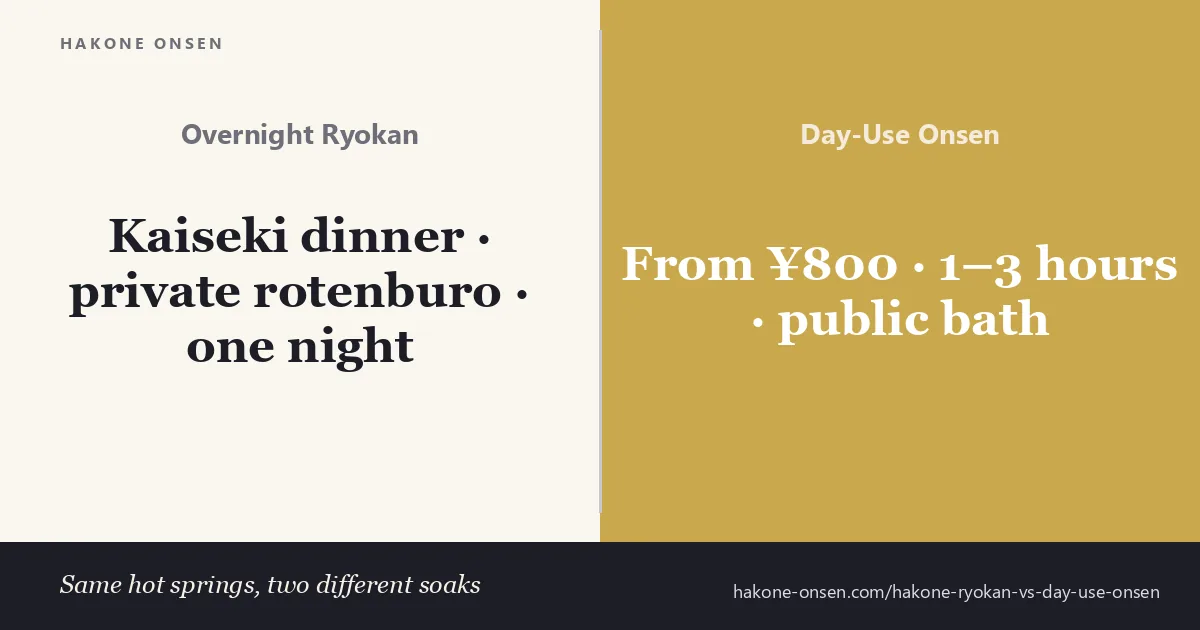
The Three Options at a Glance
| Ryokan (overnight) | Day-Use (higaeri) | Yunessun (resort) | |
|---|---|---|---|
| Time needed | One night+ | 1–3 hours | Half to full day |
| Typical cost | High (room + meals) | Low entry; private rooms extra | Mid; per zone or combined pass |
| Tattoos | Easy via in-room private bath | Varies; some allow, private rooms help | No issue in swimsuit zone |
| Privacy | Maximum (in-room rotenburo) | Public, or rent a kashikiri room | Public, mixed-gender pools |
| Food | Multi-course kaiseki dinner | None (bring your own plans) | Cafés and restaurants on site |
| Best for | Couples, a special trip | Day-trippers, budget soakers | Families, tattooed guests, mixed groups |
Ryokan: The Full Overnight Ritual
A ryokan is a traditional Japanese inn, and staying in one is the deepest way to experience Hakone onsen. The night usually includes a tatami room, a yukata robe, a multi-course kaiseki dinner of seasonal local dishes, breakfast, and access to the inn’s own indoor and open-air baths. Many Hakone ryokan also offer rooms with a private open-air bath (rotenburo) on the balcony or terrace — your own hot spring, looking out over the mountains.
That in-room bath is the single best reason to splurge on a ryokan: it’s the simplest solution if you have tattoos, want privacy, or are travelling as a couple, because no public bathing rules apply. Ryokan pricing spans a wide range — modest inns to luxury design ryokan — and is normally quoted per person, with dinner and breakfast included, so compare like-for-like.
The trade-off is time and money: a ryokan only makes sense if you’re staying overnight. But the onsen is genuinely best after dark, once the day-trippers have gone, which is exactly when a ryokan stay comes into its own. If your trip is really about the hot springs, build in one night.
Day-Use (Higaeri) Onsen: Soak Without Staying
If you can’t spare a night, higaeri onsen — day-use bathing — is the answer, and it’s why even a Hakone day trip can include a real soak. Many bathhouses and some ryokan around Hakone-Yumoto and Gora sell daytime entry without an overnight stay, so you can bathe for an hour or two and head back to Tokyo the same day.
Two well-known day-use options near Hakone-Yumoto show the range:
- Tenzan Tohji-kyo — a beloved, rustic complex of outdoor rock baths in a wooded valley. It also has private rooms, though those are generally allocated first-come on the day rather than reserved ahead, and the private rooms don’t include their own washing areas.
- Hakone Yuryo — a polished modern bathhouse with large public baths and a big set of private kashikiri rooms (each with its own washing area) that can be reserved in advance — the easiest day-use choice if you have tattoos or want guaranteed privacy.
- Kappa Tengoku — a tiny, rustic open-air bath tucked into the hillside right behind Hakone-Yumoto Station; cheap, no-frills and one of the few public baths that openly admits tattooed bathers.
One thing worth knowing before you pick: Hakone’s water itself changes by district. Around Hakone-Yumoto the springs are mostly gentle simple-alkaline and mild saline water; Gora mixes several types, including heat-holding sodium-chloride “salt” springs; the Owakudani-fed sources around Sengokuhara run to cloudy, acidic sulphur water — the milky kind with the faint eggy smell; and remote Ashinoyu, up near Lake Ashi, is known for its own distinctive sulphur springs. Choosing a bath in a different valley genuinely changes how the water feels on the skin.
Standard public day-use entry in Hakone typically runs from around ¥800 up to ¥2,500, while private kashikiri rooms — usually booked in 45-to-60-minute sessions — are priced separately, commonly from around ¥4,000 into the ¥15,000+ range depending on the venue and room. Booking a private room ahead is the reliable way to bathe with tattoos or as a mixed group.
Yunessun: The Swimsuit-Friendly Resort
Hakone Kowakien Yunessun is the outlier — a hot-spring theme park rather than a quiet bath. Its headline outdoor zone is mixed-gender and worn with a swimsuit, featuring novelty pools (wine, coffee, green tea, sake) alongside water slides and a Doctor Fish foot bath. Because you bathe clothed, Yunessun is the most tattoo-relaxed, family-friendly option in Hakone — though the park’s own rules ask that large or prominent tattoos be covered with a rash guard or waterproof sticker even in the swimsuit zone.
For a traditional soak, Yunessun also runs a separate nude bathing area called Mori-no-Yu. The two zones are ticketed individually or via a combined pass: the swimsuit Yunessun zone is around ¥2,500, the traditional Mori-no-Yu zone around ¥1,500, and a combined Passport around ¥3,500 (prices as of mid-2026). That split is handy for mixed groups — some can splash in the swimsuit pools while others want a quiet nude bath.
So Which Should You Choose?
- Choose a ryokan if Hakone is mainly about the onsen, you’re staying overnight, and you want the full kaiseki-and-rotenburo experience — especially for a couple’s trip or with tattoos (book a room with a private bath).
- Choose day-use (higaeri) if you’re on a day trip or a budget but still want a genuine soak; reserve a kashikiri room at somewhere like Hakone Yuryo if you have tattoos.
- Choose Yunessun if you’re travelling with kids, want to wear a swimsuit, have tattoos and want zero hassle, or just want a fun resort day rather than a meditative bath.
Whatever you pick, remember the standard guided day trips focus on Owakudani, the ropeway and Lake Ashi — sightseeing, not bathing — so plan your soak deliberately on top of the tour.
Ready to Book?
The easiest way to reach Hakone’s onsen country is the top-rated Hakone day trip — Owakudani, the Hakone Ropeway and Lake Ashi in one day, rated 4.7/5 by 6,839 travellers, with free cancellation up to 24 hours before. Want to bathe properly too? Pair it with our Hakone onsen etiquette and tattoo guide and time your trip with the best time to visit Hakone.
See Hakone & Mt Fuji — One Day from Tokyo
A full-day trip to Owakudani’s hot-spring valley, the Hakone Ropeway, Lake Ashi and Mt Fuji — top-rated, with hotel-area pickup, from $60 per person with free cancellation.
Check Availability & Book