Hakone Onsen Etiquette & Tattoo Guide
Step-by-step Hakone onsen etiquette — how to wash, towel and soak — plus tattoo-friendly options, private kashikiri baths and the Yunessun workaround.
A first soak in a Hakone hot spring is one of Japan’s great simple pleasures — but the unwritten rules trip up almost every first-timer. The good news: onsen etiquette is short, logical and easy to get right once someone walks you through it. This guide covers the full bathing ritual step by step, what to do if you have tattoos, and when a private or swimsuit-friendly bath is the smarter choice. For the bigger picture of where Hakone fits as Japan’s hot-spring capital, start with our Hakone onsen overview.
The Golden Rule: Wash Before You Soak
The single most important thing to understand is that an onsen bath is for soaking, not for cleaning. You arrive clean. Every traditional bathhouse has a row of seated shower stations — a low stool, a handheld shower, a bowl, and soap and shampoo — and you wash and rinse there thoroughly before you ever step into the communal pool. Rinse away every trace of suds. Walking into the shared water without washing first is the one mistake that genuinely upsets other bathers.
Onsen Bathing, Step by Step
Here is the full sequence from the door to the dressing room:
- Pay and remove your shoes at the entrance; lockers or cubbies hold your footwear.
- Split by gender. Look for the noren curtains — red/pink (女) for women, blue (男) for men. Most baths are gender-separated.
- Undress completely in the changing room and leave clothes in a basket or locker. Traditional onsen are nude; there is no swimwear.
- Take only your small towel into the bathing area. This modesty towel never goes into the water — fold it and rest it on the rockside or on your head.
- Wash at a shower station. Sit on the stool, soap up, shampoo, and rinse completely.
- Rinse, then enter slowly. Before stepping in, ladle the bath water over your body several times — a practice called kakeyu that rinses off the last of the soap and lets your body acclimate to the heat. Then ease in; the water is hot.
- Soak, don’t swim. Keep your hair and towel out of the water, no splashing, keep voices low.
- Rest between soaks if you feel light-headed — onsen water is hot enough that long single sessions can leave you dizzy.
- Towel off lightly before re-entering the changing room so you don’t drip everywhere.
Most onsen run their baths between 38°C and 43°C, with the main pools usually sitting around 41–42°C — comfortably hot, hotter than a typical Western bath. If a pool feels too intense, look for a cooler tub; many venues offer several at different temperatures.
A Few Things That Surprise First-Timers
| Do | Don’t |
|---|---|
| Tie up long hair so it stays out of the water | Put your head (or hair) under the surface |
| Keep the small towel out of the bath | Bring a large towel into the bathing area |
| Stay quiet and relaxed | Take photos — phones are banned in bathing areas |
| Drink water before and after | Soak straight after heavy alcohol |
| Rinse off before and after soaking | Use the bath to wash |
Hydration matters more than people expect: a long hot soak is dehydrating, so drink water before and after, and don’t bathe on an empty stomach or straight after drinking.
Tattoos at Hakone Onsen: The Honest Picture
Many traditional onsen still turn away guests with visible tattoos, because of the long historical association between irezumi and organised crime in Japan. The policy is inconsistent — some venues ban tattoos of any size, some allow small ones, some don’t mind at all — so the safest approach is never to assume. There are four reliable ways around it, in rough order of certainty:
- Book a ryokan room with a private open-air bath (rotenburo). When the bath is in your own room, no one sees your ink and there is no policy to worry about. This is the most foolproof option and the most relaxing.
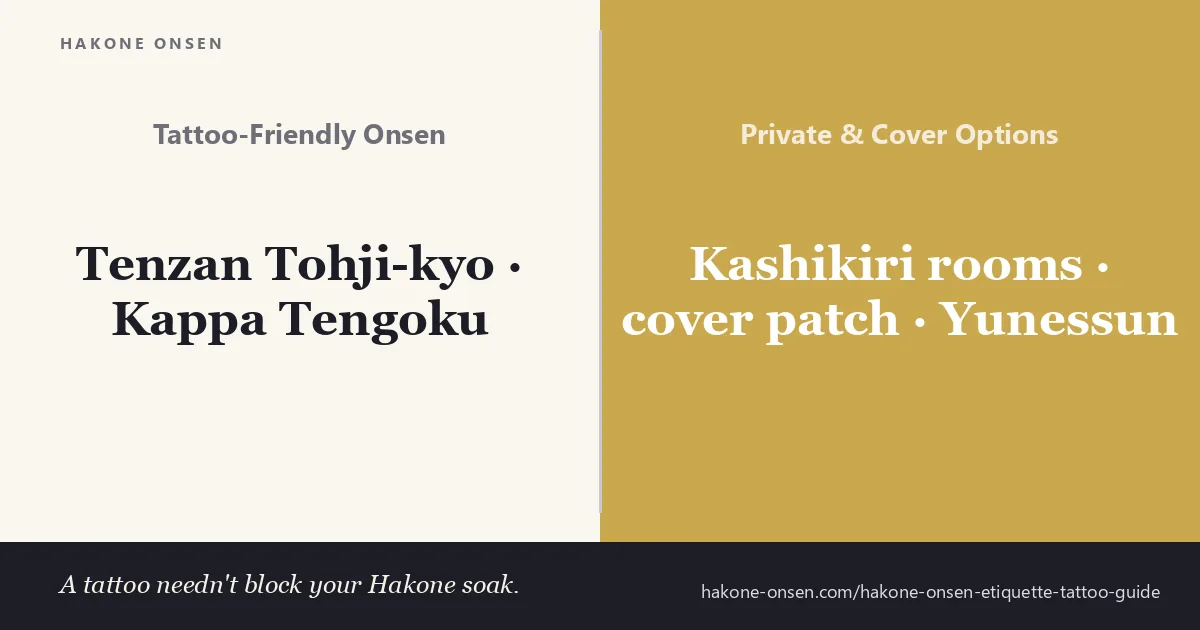
- Reserve a private kashikiri bath. Several Hakone day-use bathhouses rent private rooms by the hour for couples, families or anyone wanting privacy. Hakone Yuryo, near Hakone-Yumoto, has a large set of private kashikiri rooms that can be reserved in advance and include their own washing areas — a strong choice if you have tattoos. At Tenzan Tohji-kyo, also near Hakone-Yumoto, private rooms tend to be first-come on the day rather than reservable.
- Choose a venue that admits tattooed bathers. A handful of Hakone public baths are widely listed as tattoo-friendly — Tenzan Tohji-kyo and Kappa Tengoku (the rustic bathhouse right behind Hakone-Yumoto Station) among them. Policies can still change and large tattooed groups are sometimes turned away, so confirm with the venue before you travel.
- Use a cover patch for a small tattoo. Waterproof skin-tone patches — sold at Don Quijote, drugstores like Matsumoto Kiyoshi and online — typically hide a design up to around postcard size (roughly 10×15 cm) and are accepted at some baths, but they won’t cover large work.
If you’d simply rather not deal with any of it, the easiest answer is Yunessun (below).
When a Swimsuit Bath Makes Sense: Yunessun
Hakone Kowakien Yunessun is a hot-spring theme park where the outdoor pools — including the famous wine, coffee, green-tea and sake baths — are mixed-gender and worn with a swimsuit. Because you bathe clothed, it’s the most tattoo-relaxed, family-friendly option in Hakone — though note the park’s own rules ask that large or prominent tattoos be covered with a rash guard or waterproof sticker even in the swimsuit zone, which swimwear makes easy. Yunessun also has a separate traditional nude bathing area called Mori-no-Yu for a more classic soak. You can pay for either zone or buy a combined pass, so it suits mixed groups where some want the swimsuit pools and others want a quiet traditional bath.
Quick Etiquette Cheat Sheet
- Arrive clean is the wrong idea — arrive, then wash, then soak.
- Nude in traditional baths; swimsuit only at Yunessun’s outdoor zone.
- Small towel never touches the water.
- No photos, no phones, no swimming, low voices.
- Tattoos: private rotenburo, kashikiri room, tattoo-friendly venue, or Yunessun.
Get these basics right and you’ll bathe like a local on your first try.
Ready to Book?
Most travellers reach Hakone’s onsen country on a guided day trip first, then return to soak — and the day trip is the easy way to see Owakudani, the Hakone Ropeway and Lake Ashi without juggling transfers. Our featured Hakone day trip is rated 4.7/5 by 6,839 travellers, runs with licensed local operators and English-speaking guides, and offers free cancellation up to 24 hours before. Check availability and book, or read our Hakone ryokan vs day-use onsen guide to pick where to actually bathe.
See Hakone & Mt Fuji — One Day from Tokyo
A full-day trip to Owakudani’s hot-spring valley, the Hakone Ropeway, Lake Ashi and Mt Fuji — top-rated, with hotel-area pickup, from $60 per person with free cancellation.
Check Availability & Book