Hakone Free Pass from Tokyo: The Complete Transport Guide
How to get to Hakone from Tokyo — Hakone Free Pass costs, the Romancecar, the full loop route, and whether the pass beats paying as you go. Updated June 2026.
Getting to Hakone from Tokyo is genuinely easy — the hard part is choosing how. There are three sensible answers: the Hakone Free Pass for independent loop-touring, the comfortable Romancecar for a fast direct run, or a guided day trip that removes the planning entirely. This guide breaks down the costs, the route, and which option suits which kind of traveller. For the wider context of what you’ll actually see, start with our Hakone onsen overview.
The Three Ways to Reach Hakone
| Option | Best for | Roughly |
|---|---|---|
| Hakone Free Pass | Independent travellers doing the full loop | 2-day or 3-day pass |
| Romancecar (reserved express) | A fast, comfortable direct ride to Hakone-Yumoto | around 75–85 min from Shinjuku |
| Guided day trip | No planning, hotel-area pickup, guide included | from $60 per person |
What the Hakone Free Pass Actually Covers
The Hakone Free Pass is an Odakyu travel pass that bundles your round trip from Tokyo plus unlimited rides on almost every form of transport inside the Hakone area for the duration of the pass. That includes:
- The Hakone Tozan Railway — the switchback mountain train up to Gora
- The Hakone Tozan Cable Car — the funicular from Gora to Sounzan
- The Hakone Ropeway — the gondola over Owakudani
- The Hakone Sightseeing Cruise — the “pirate ships” on Lake Ashi
- The Hakone Tozan Buses and several other local lines
In other words, one pass runs the entire classic loop. You tap or show it at each leg instead of buying separate tickets, which is the whole appeal: Hakone’s network is a patchwork of operators, and paying individually adds up fast.
From Shinjuku, the 2-day pass is around ¥7,100 and the 3-day pass around ¥7,500 (prices revised in October 2025); children aged 6–11 pay around ¥1,100 for the 2-day version. The small jump to the 3-day version is worth it if you’re staying overnight to soak in an onsen after the day-trippers leave. You can buy the pass at the Odakyu Sightseeing Service Center in Shinjuku, at station ticket machines, or as a digital pass in Odakyu’s EMot app — which also sells digital Romancecar seats for a little less than the paper surcharge.
The Romancecar: Worth the Surcharge?
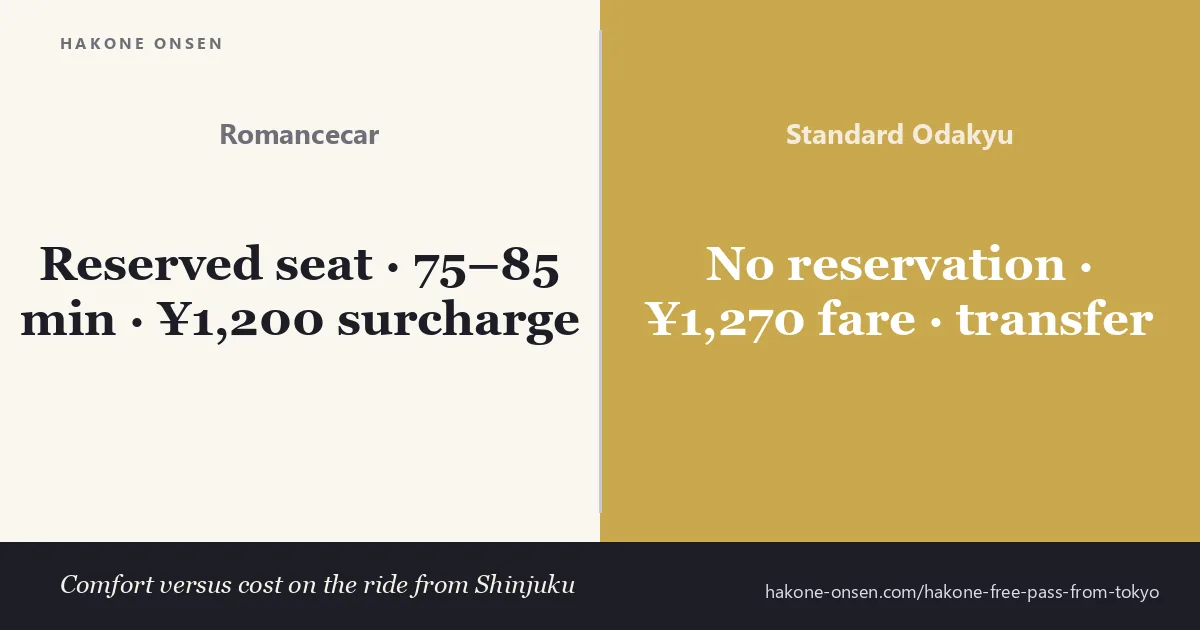
The Free Pass gets you to Hakone on ordinary Odakyu trains. The Romancecar is Odakyu’s reserved-seat limited express — faster, with guaranteed seats and panoramic front windows on some trains — and it runs straight through from Shinjuku to Hakone-Yumoto in roughly 75 to 85 minutes. It is not included in the Free Pass; it costs an extra limited-express surcharge of around ¥1,200 each way on top of the pass or a regular ticket.
For most visitors that surcharge is money well spent on the way out — you arrive rested, with luggage stowed, ready to start the loop — even if you take an ordinary train back. If you’re travelling light and on a budget, the standard Odakyu service (basic one-way fare around ¥1,270 from Shinjuku without the Romancecar) does the same journey for less, just with a transfer and no reserved seat.
Is the Free Pass Worth It?
The Free Pass pays for itself quickly if you do the full loop. A single circuit uses the train, cable car, ropeway, a Lake Ashi cruise and a bus or two — buy those individually and you’re already past the cost of the round-trip fares the pass also includes. The Lake Ashi sightseeing cruise alone is around ¥1,700 for a single leg, and that’s just one piece of the day.
The pass is less worthwhile if you only plan to visit one or two spots — say, a quick trip to Hakone-Yumoto for a day-use bath and back. In that narrow case, point-to-point tickets can be cheaper. But for anyone touring the caldera properly, the Free Pass is the standard choice for good reason — and it also unlocks small discounts at around 70 area attractions, from the Hakone Open-Air Museum to Yunessun, which quietly sweetens the value.
The Classic Hakone Loop, in Order
Done independently, the circuit flows naturally in one direction so you rarely backtrack:
- Shinjuku → Hakone-Yumoto by Romancecar or ordinary Odakyu train.
- Hakone-Yumoto → Gora on the Hakone Tozan Railway, a slow, scenic climb that reverses direction at three switchbacks to manage the steep grade (and the hydrangea line in June).
- Gora → Sounzan on the cable car (funicular).
- Sounzan → Owakudani → Togendai on the Hakone Ropeway, gliding over the steaming volcanic valley and its black-egg stalls.
- Togendai → Moto-Hakone / Hakone-machi by sightseeing cruise across Lake Ashi, past the floating torii of Hakone Shrine.
- Back to Hakone-Yumoto by Hakone Tozan Bus, then the train back to Tokyo.
The whole loop is comfortably a full day. If you’re staying overnight, you can travel hands-free: the Hakone Carry Service counter at Hakone-Yumoto Station forwards luggage to area hotels for around ¥1,500 a bag when you drop it off by around noon. Note that Owakudani sits on an active volcanic system: the ropeway and the valley occasionally close or restrict access when sulphur-gas levels spike, and the Owakudani nature trail now requires a guided reservation. Check the day’s status before you set out — and keep your plans flexible.
When a Guided Day Trip Beats Doing It Yourself
The loop is doable solo, but it’s a lot of connections, queues and timing — especially on a first visit, with luggage, or on a tight schedule. A guided coach day trip collapses all of it into one booking: pickup near major Tokyo stations, an English-speaking guide, the ropeway leg and the highlights handled for you, with the Lake Ashi cruise built into the route. Our featured Hakone day trip runs from $60 per person, is rated 4.7/5 by 6,839 travellers, and offers free cancellation up to 24 hours before. It’s the path of least resistance if you’d rather look out the window than read a transfer map.
Ready to Book?
If you want Hakone without the logistics, the top-rated Hakone day trip handles Owakudani, the Hakone Ropeway and Lake Ashi in a single day with hotel-area pickup. Prefer to soak overnight? Read our Hakone ryokan vs day-use onsen guide and best time to visit Hakone before you lock in dates.
See Hakone & Mt Fuji — One Day from Tokyo
A full-day trip to Owakudani’s hot-spring valley, the Hakone Ropeway, Lake Ashi and Mt Fuji — top-rated, with hotel-area pickup, from $60 per person with free cancellation.
Check Availability & Book