Best Time to Visit Hakone Onsen
When to visit Hakone — autumn foliage, winter Fuji clarity, June hydrangeas and the rainy season. A month-by-month guide to onsen, weather and crowds.
Hakone rewards a visit in every season — but which season you choose changes the trip completely. Come for blazing autumn foliage, crisp winter Fuji views, June hydrangeas along the mountain railway, or simply the year-round pleasure of soaking in volcanic water. This guide walks through the seasons and months so you can match your trip to what matters most: scenery, hot springs, clear Mount Fuji, or fewer crowds. For the bigger picture of the region, start with our Hakone onsen overview.
The Short Answer
| If you want… | Go in… |
|---|---|
| Autumn foliage (koyo) | Mid to late November |
| The clearest Mount Fuji views | December–January |
| Hydrangeas on the mountain railway | Mid to late June |
| Fewest crowds | Winter weekdays (excluding New Year) |
| Spring blossom and fresh greenery | April–May |
| To avoid the wettest weather | Skip the early June–mid July rainy season |
The onsen themselves are wonderful year-round — arguably best in cold weather, when soaking outdoors in a steaming open-air bath against chilly mountain air is at its most magical.
Autumn (September–November): The Headline Season
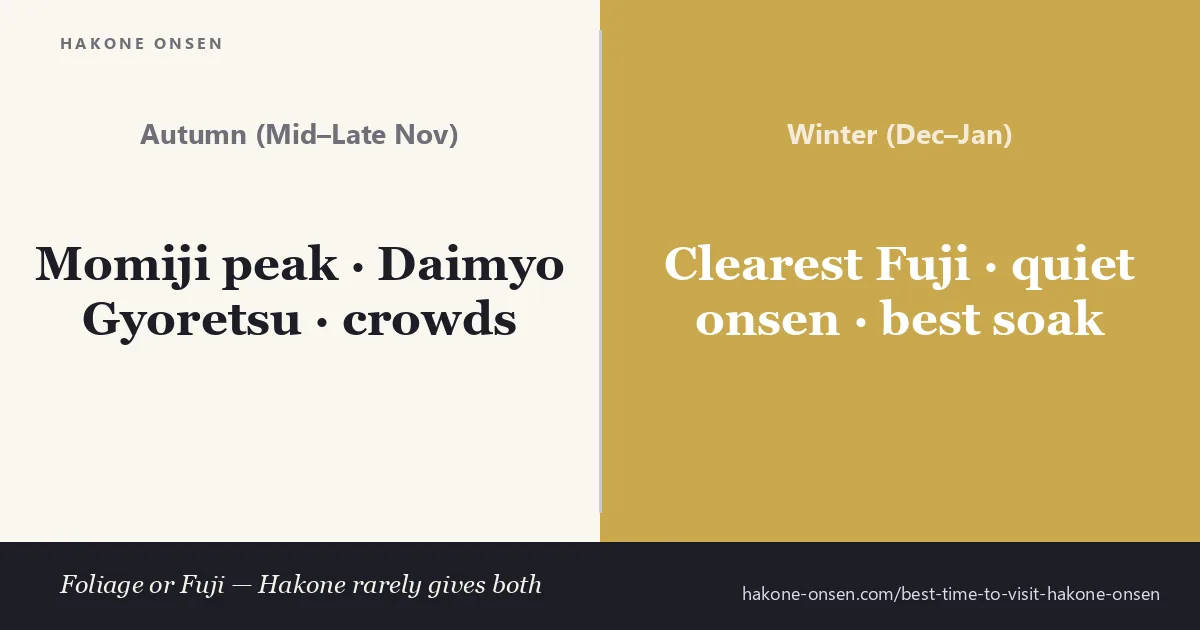
Autumn is Hakone’s showcase. The caldera’s maples and larches turn red and gold, and the colour looks spectacular from the Hakone Ropeway, around Lake Ashi, and through the windows of the Tozan mountain railway. Peak foliage generally arrives mid to late November around Lake Ashi and Gora, a little earlier at the highest elevations in late October. Pair that with autumn’s clearer, drier air and you get scenery and Fuji visibility together — which is exactly why it’s the busiest, most photographed time to come. Book accommodation early and start your days early to beat the ropeway queues. Two autumn extras are worth timing for: the golden Sengokuhara pampas-grass (susuki) field, at its shimmering best from late September into early November, and the Hakone Daimyo Gyoretsu, a costumed feudal-lord’s procession that parades through Hakone-Yumoto every November 3.
Winter (December–February): Best Fuji, Best Soak, Fewest People
Winter is the connoisseur’s choice. The cold, dry air delivers the clearest Mount Fuji views of the year — December and January are the standouts — and Hakone rarely gets the heavy snow that closes mountain roads further north. Crucially, this is when an onsen is most rewarding: stepping into 40-plus-degree water with frosty air on your face is the whole point of a Japanese winter bath.
Crowds thin out on winter weekdays (the big exception is the New Year holiday, when domestic travel peaks). Pack warm layers for the windy ropeway and lakeside, and aim for early mornings, when Fuji is most reliably out before afternoon cloud builds.
Spring (March–May): Blossom and Mild Air
Spring brings cherry blossom at lower elevations, fresh greenery climbing the slopes, and comfortable hiking weather. The Hayakawa riverbank at Miyagino is the area’s best-known blossom spot, with around 120 trees usually peaking in early to mid-April. Cherry blossom timing shifts year to year and arrives later up in the mountains than down in Tokyo, so check forecasts if blossom is your goal. Fuji visibility is decent but less reliable than winter as humidity creeps up. The Golden Week holiday in early May is a major domestic travel period — lovely weather, but expect crowds and book ahead.
Early Summer & the Rainy Season (June–mid July)
Japan’s rainy season (tsuyu) typically runs from early June to mid-July in the Hakone/Kanto region. It’s the most cloud-prone, least reliable window for Mount Fuji, and the wettest underfoot — but it has one glorious upside: hydrangeas. From mid to late June the Hakone Tozan Railway becomes the famous “hydrangea train,” its switchback track lined with blue and purple blooms, with special evening illuminated runs. Rain also means lush, misty mountains and noticeably thinner crowds. If you don’t mind a poncho and you’re here for the onsen and the greenery rather than Fuji, early summer is underrated.
High Summer (mid July–August): Lush but Cloudy
After the rains lift, Hakone is green and alive, and the mountain air is cooler than sweltering Tokyo — a genuine relief in midsummer. The catch is Fuji: summer is the most cloud-prone season, so the mountain often hides behind haze, and it’s a busy holiday period. Come for the cool air, the lake and the onsen; treat a Fuji sighting as a lucky bonus. Summer is also Hakone’s festival stretch: Lake Ashi hosts a run of evening fireworks from July 31 to August 5, opening with the Kosui Matsuri lake festival at Hakone Shrine on July 31, and on August 16 the Daimonji-yaki bonfire burns a giant 大 character into the slope of Mt Myojogatake above Gora.
Month-by-Month Cheat Sheet
| Month | Highlights | Crowds | Fuji odds |
|---|---|---|---|
| Jan | Clearest Fuji, snowy onsen feel | Low (post New Year) | Excellent |
| Feb | Cold, clear, quiet | Low | Excellent |
| Mar–Apr | Blossom, mild | Building | Fair |
| May | Greenery; Golden Week peak early May | High early month | Fair |
| Jun | Hydrangea railway; rainy season starts | Lower | Poor |
| Jul | Rain easing mid-month; lush | Building | Poor |
| Aug | Cool escape; lake fireworks & Daimonji (16th) | High | Poor |
| Sep–Oct | Early foliage up high; Sengokuhara pampas grass | Building | Improving |
| Nov | Peak autumn colour; Daimyo Gyoretsu (3rd) | Very high | Good |
| Dec | Clear Fuji, festive; New Year crowds late | Low–Mid | Excellent |
A Note on Weather and the Ropeway
Whatever month you choose, two things are out of anyone’s control. First, Mount Fuji is shy — no tour or season can guarantee it appears, so treat a sighting as a gift. Second, the Hakone Ropeway over Owakudani sits on an active volcanic system and can occasionally close or restrict access when sulphur-gas levels rise; the Owakudani nature trail now requires a guided reservation. Always check the day’s status and keep a little flexibility in your plan.
Ready to Book?
Once you’ve picked your season, the simplest way to see Hakone is the top-rated Hakone day trip — Owakudani, the Hakone Ropeway and Lake Ashi in one day, rated 4.7/5 by 6,839 travellers, with free cancellation up to 24 hours before, so shifting dates around the weather is easy. Going to soak as well? Read our Hakone ryokan vs day-use onsen guide and how to get to Hakone from Tokyo.
See Hakone & Mt Fuji — One Day from Tokyo
A full-day trip to Owakudani’s hot-spring valley, the Hakone Ropeway, Lake Ashi and Mt Fuji — top-rated, with hotel-area pickup, from $60 per person with free cancellation.
Check Availability & Book